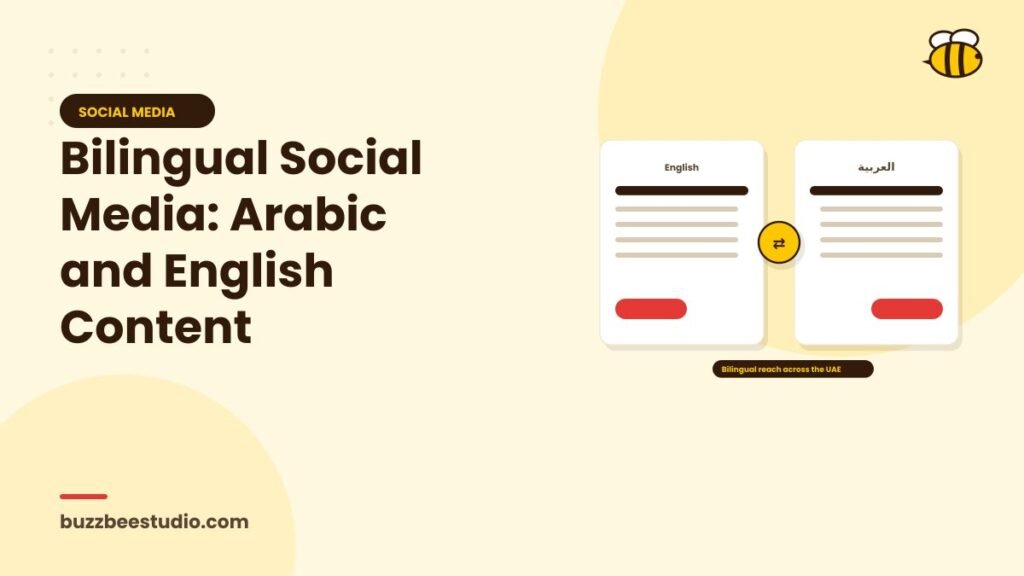
The UAE is home to Emiratis, Arab expatriates and people from all over the world. English is widely used in business, while Arabic is the official language and the preferred language for many residents. For brands, bilingual social media can broaden reach and show respect for the local culture. But doing it well takes planning.
Why bilingual content matters
- Wider reach: connect with Arabic-speaking and English-speaking audiences.
- Cultural respect: Arabic content signals commitment to the local market.
- Better engagement: people respond more to content in their preferred language.
- Competitive advantage: many brands still neglect quality Arabic content.
Know your audience
Before deciding on your approach, understand who you're talking to:
- What share of your customers prefer Arabic?
- Which nationalities are you targeting?
- Which platforms do they use? Some audiences favour Snapchat or Instagram, others LinkedIn or TikTok.
- Do they prefer Gulf dialect, Modern Standard Arabic or a mix?
Use platform insights and customer data to guide decisions.
Approaches to bilingual social media
Bilingual posts
Each post includes both Arabic and English captions, with text overlays in both languages or language-neutral visuals.
Pros: one account, one post, inclusive. Cons: captions get long; visuals with text can look crowded.
Alternating posts
Some posts in Arabic, some in English, on the same account.
Pros: cleaner posts. Cons: followers may see content in a language they don't prefer.
Separate accounts
Different accounts for Arabic and English audiences.
Pros: fully tailored content. Cons: more work; splits your following.
Language-targeted ads
For paid campaigns, create separate Arabic and English ads targeted by language. This is usually the most effective approach for ads.
Many brands use bilingual or English posts organically, with separate Arabic and English ads.
Go beyond translation
Direct translation often sounds unnatural. Instead:
- Transcreate: adapt the message to sound natural and culturally relevant in each language.
- Use native copywriters for Arabic content.
- Choose the right dialect and tone for your audience. Gulf dialect may feel more personal for local audiences, while Modern Standard Arabic suits formal communications.
- Adapt humour, idioms and references that may not translate.
Design for both languages
- Right-to-left layouts for Arabic text and graphics.
- Arabic fonts that are readable and match your brand style.
- Balanced layouts when both languages appear together.
- Captions and subtitles in both languages for videos.
- Visual storytelling that works regardless of language.
Cultural sensitivity
- Respect religious and cultural values in imagery and messaging.
- Be thoughtful during Ramadan and religious occasions.
- Celebrate national events like UAE National Day appropriately.
- Avoid stereotypes and ensure diverse representation.
Have native speakers review content before publishing.
Community management in both languages
If you post in Arabic, be ready to respond in Arabic. Make sure team members or partners can handle comments and messages in both languages with the same speed and quality.
Hashtags and search
Use relevant Arabic hashtags as well as English ones. Arabic hashtags can help content appear in Arabic searches and trends.
Influencers and creators
Partner with Arabic-speaking creators for authentic Arabic content, and English-speaking creators for expat audiences. Ensure all creators meet UAE regulations for promotional content.
Measuring performance
Compare Arabic and English content on:
- Reach and engagement.
- Follower growth by audience.
- Leads and sales from language-targeted campaigns.
- Cost per result for Arabic vs English ads.
Use insights to adjust your language mix.
Build a bilingual workflow
Creating content in two languages needs a clear process. Plan posts in both languages at the same time, with native writers working from the same brief. Allow time for review by native speakers before publishing. Keep a glossary of approved Arabic and English terms for your products and services, so wording stays consistent across posts, ads and your website.
Start small if needed
If resources are limited, start with Arabic versions of your most important posts and ads, then expand as you see engagement grow. It's better to publish less Arabic content of high quality than lots of rushed translations.
Review results by language
Check performance every month and adjust.
Final thoughts
Bilingual social media helps UAE brands connect with a wider, more diverse audience. Understand your audience, choose a sensible structure, transcreate rather than translate, design for both languages and respond in the language customers use. Done well, it shows respect and builds stronger relationships.
Buzz Bee Studio creates bilingual Arabic and English social content for UAE brands. Get in touch to reach both audiences effectively.