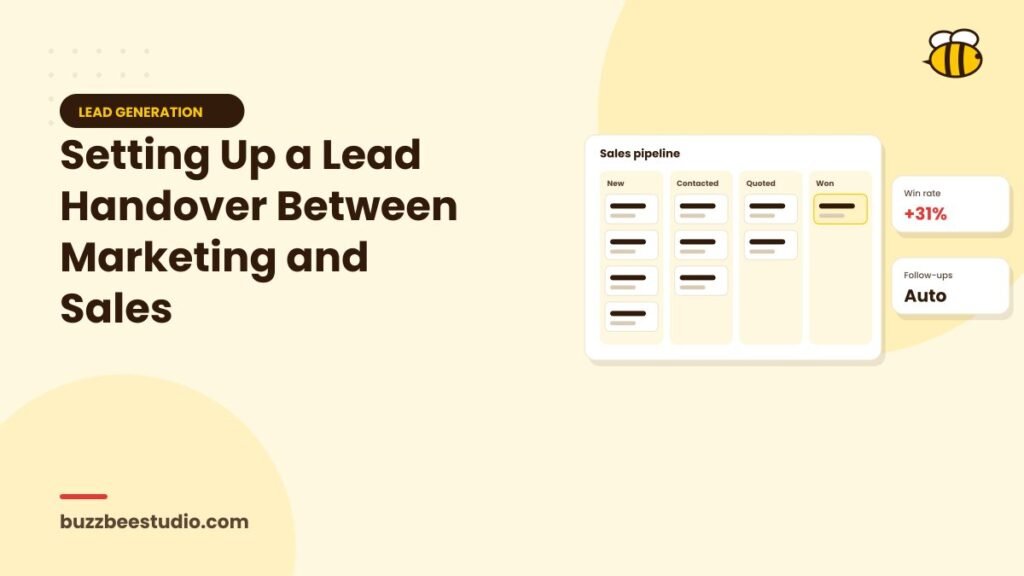
Marketing generates the leads; sales turns them into customers. But in the space between the two, things often go wrong. Leads arrive without context, sit in the wrong inbox, get contacted twice or not at all. A clear handover process fixes this and can lift your results without any extra ad spend.
Common handover problems
- Leads arrive by email and get buried.
- Nobody knows who's responsible for each lead.
- Sales doesn't know where the lead came from or what they saw.
- Marketing never hears which leads became customers.
- Arguments about lead quality without data to settle them.
Step 1: Agree on definitions
Marketing and sales need a shared language. Define:
- Lead: anyone who has enquired or shared their details.
- Marketing qualified lead (MQL): a lead that meets basic criteria, such as right location, relevant service and genuine contact details.
- Sales qualified lead (SQL): a lead that sales has confirmed has need, budget and a timeline.
- Opportunity: a lead that has received a quote or proposal.
- Customer: a closed sale.
Write these down and make sure everyone agrees.
Step 2: Centralise leads
Send every lead, whether from forms, calls, WhatsApp, social media, events or referrals, into one place, ideally a CRM. If you don't have a CRM yet, a shared spreadsheet or a structured WhatsApp Business setup with labels is better than scattered inboxes.
Step 3: Capture context
Each lead should arrive with useful information:
- Name and contact details.
- Service or product of interest.
- Source: campaign, ad, keyword or channel.
- Landing page or offer they responded to.
- Any answers to qualifying questions.
- Date and time of enquiry.
This helps salespeople personalise the first conversation: "I see you were looking at our villa deep-cleaning package…"
Step 4: Assign ownership
Decide how leads are distributed:
- By territory or area.
- By service type.
- By rotation, so leads are shared fairly.
- By lead score, with hot leads going to senior salespeople.
Every lead should have one clear owner. Automate assignment if your CRM allows.
Step 5: Set response time targets
Agree a service level, for example:
- Hot leads: contacted within 5–15 minutes during working hours.
- Other leads: contacted the same day.
- Out-of-hours leads: acknowledged automatically and contacted first thing next working day.
Set up instant notifications by mobile app, WhatsApp or SMS so salespeople know immediately.
Step 6: Define the follow-up process
Write down the steps sales should take:
- First contact attempt by call and WhatsApp.
- Second and third attempts at set intervals.
- Qualification questions.
- Quote or booking.
- Follow-ups after the quote.
- Marking the outcome in the CRM.
Consistency makes performance measurable.
Step 7: Record outcomes
Every lead should end with a status: won, lost (with a reason), not qualified (with a reason) or in nurture. Common reasons include price, timing, outside area, chose competitor or no response.
These reasons are invaluable for improving marketing.
Step 8: Close the feedback loop
Hold a short weekly meeting between marketing and sales to review:
- Lead volume and quality by source.
- Response times.
- Conversion rates at each stage.
- Common objections and reasons for losing deals.
- Changes to campaigns or messaging.
Share data, not opinions. It turns disagreements into improvements.
Step 9: Send outcomes back to ad platforms
Google Ads and Meta can optimise for qualified leads and sales if you send them that data through offline conversion imports or CRM integrations. This often improves lead quality over time.
Step 10: Recycle unready leads
Leads that aren't ready now shouldn't be lost. Return them to marketing for nurturing through email, WhatsApp updates and retargeting, with clear rules for when they come back to sales.
Celebrate shared wins
When a campaign brings in a great customer, share the story with both teams. Recognising joint success builds trust and encourages collaboration.
Document and train
Write the handover process down in a simple one-page guide, including definitions, response times, follow-up steps and outcome codes. Use it to train new team members and review it every few months as your business grows. A documented process stays consistent even when people change roles.
Final thoughts
A good handover between marketing and sales makes sure no lead is wasted and both teams learn from every enquiry. Agree definitions, centralise leads, assign ownership, respond fast and share results. It's one of the simplest ways to grow sales from the marketing you already do.
Buzz Bee Studio sets up lead routing, CRM integrations and reporting so marketing and sales work as one team. Get in touch to tighten your handover.