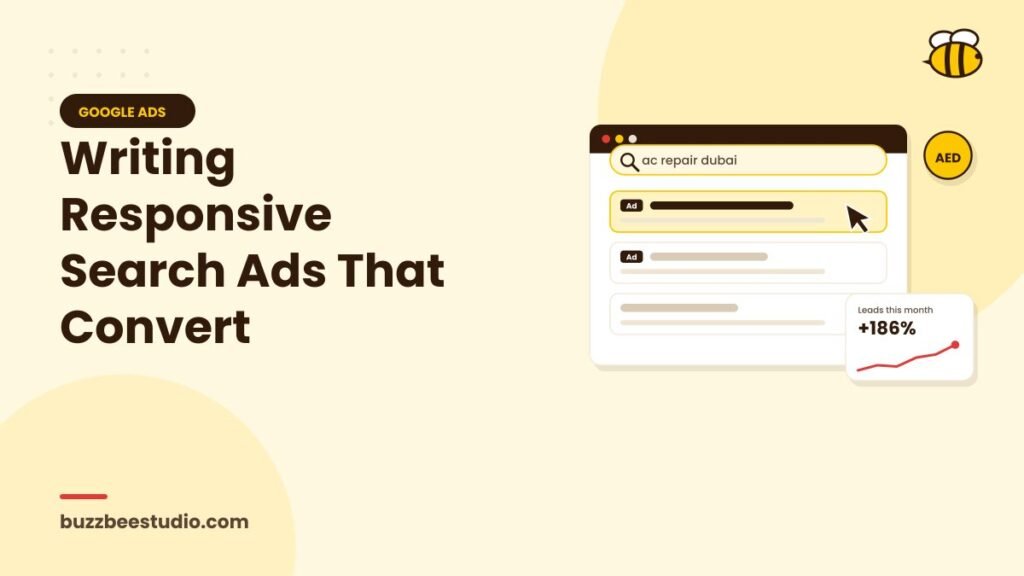
Responsive search ads (RSAs) are the standard text ad format in Google Search campaigns. Instead of writing one fixed ad, you provide multiple headlines and descriptions, and Google tests combinations to find what works best for each search. Done well, RSAs can improve relevance and performance. Done poorly, they produce generic, confusing ads.
How responsive search ads work
You provide:
- Up to 15 headlines (up to 30 characters each).
- Up to 4 descriptions (up to 90 characters each).
- A final URL and display path.
Google shows up to three headlines and two descriptions at a time, choosing combinations based on the search, device and other signals. Over time, it learns which combinations perform better.
Start with the customer
Before writing, consider:
- What is the person searching for?
- What problem do they want solved?
- What would make them choose you over competitors?
- What action do you want them to take?
Types of headlines to include
Provide variety so Google has useful combinations:
Keyword and service headlines
- "Deep Cleaning in Dubai"
- "Villa Deep Cleaning Experts"
Benefit headlines
- "Spotless Home in One Visit"
- "Save Time, We Do the Work"
Differentiator headlines
- "Same-Week Availability"
- "Trained & Insured Teams"
- "Eco-Friendly Products"
Offer headlines
- "Free Quote in Minutes"
- "Seasonal Offer This Month"
Proof headlines
- "Rated Highly on Google"
- "[NUMBER]+ Homes Cleaned"
Use only claims you can genuinely support.
Call-to-action headlines
- "Book Online Today"
- "Message Us on WhatsApp"
Brand headline
- "Buzz Bee Cleaning Services"
Writing descriptions
Descriptions give more detail. Include:
- What's included in the service.
- Key benefits and differentiators.
- Proof or reassurance, such as guarantees and reviews.
- A clear call to action.
Example: "Professional deep cleaning for apartments and villas. Trained teams, all equipment included. Get a free quote today."
Make every combination make sense
Because headlines can appear in any order, each should stand alone. Avoid headlines that only make sense together, and avoid repeating the same idea several times.
Use pinning sparingly
You can pin headlines or descriptions to specific positions, for example always showing your main keyword headline first. Pinning gives control but reduces combinations Google can test. Pin only when necessary, such as for legal disclaimers or essential messaging, and consider pinning two or three options to a position rather than just one.
Include keywords naturally
Including your keywords in headlines improves relevance and Ad Strength. But don't stuff every headline with the same keyword; variety is important.
Consider dynamic features
- Keyword insertion can insert the searched keyword into your ad. Use carefully so ads still read naturally.
- Location insertion can show the user's city.
- Countdown customisers can show time remaining for offers.
Test these and monitor how they appear.
Ad Strength
Google rates RSAs from "Poor" to "Excellent" based on the number, variety and relevance of your headlines and descriptions. Ad Strength is a helpful guide but not a performance metric. Focus on real results, such as conversions and cost per lead, while aiming for good Ad Strength.
Add assets to support your ads
Assets expand your ad with extra information:
- Sitelinks to key pages.
- Callouts highlighting benefits.
- Structured snippets listing services.
- Call assets with your phone number.
- Images and business logo.
- Lead form assets where suitable.
Assets make ads larger, more informative and often more clickable.
Match the landing page
Your ad's promise should continue on the landing page. If your headline says "Free Quote in Minutes", make it easy to get a quick quote on the page.
Arabic ads
If you target Arabic speakers, write separate Arabic RSAs with native copywriting, sending clicks to Arabic landing pages. Check how character limits affect Arabic text.
Test and improve
- Review asset performance ratings in Google Ads to see which headlines and descriptions perform best.
- Replace low performers with new ideas.
- Test different offers, angles and calls to action.
- Run more than one RSA per ad group only if you have enough traffic to learn from them.
Judge performance by conversions, not just clicks or click-through rate.
Common mistakes
- Writing very similar headlines.
- Using only generic phrases like "Best Service".
- Making claims you can't support.
- Over-pinning.
- Ignoring the landing page experience.
Final thoughts
Great responsive search ads combine relevance, clear benefits, genuine proof and strong calls to action. Give Google plenty of varied, high-quality headlines and descriptions, keep the landing page consistent, and keep testing. Your ads will earn more clicks from the right people.
Buzz Bee Studio writes and tests Google Ads copy for UAE businesses. Get in touch for ads that bring quality leads.